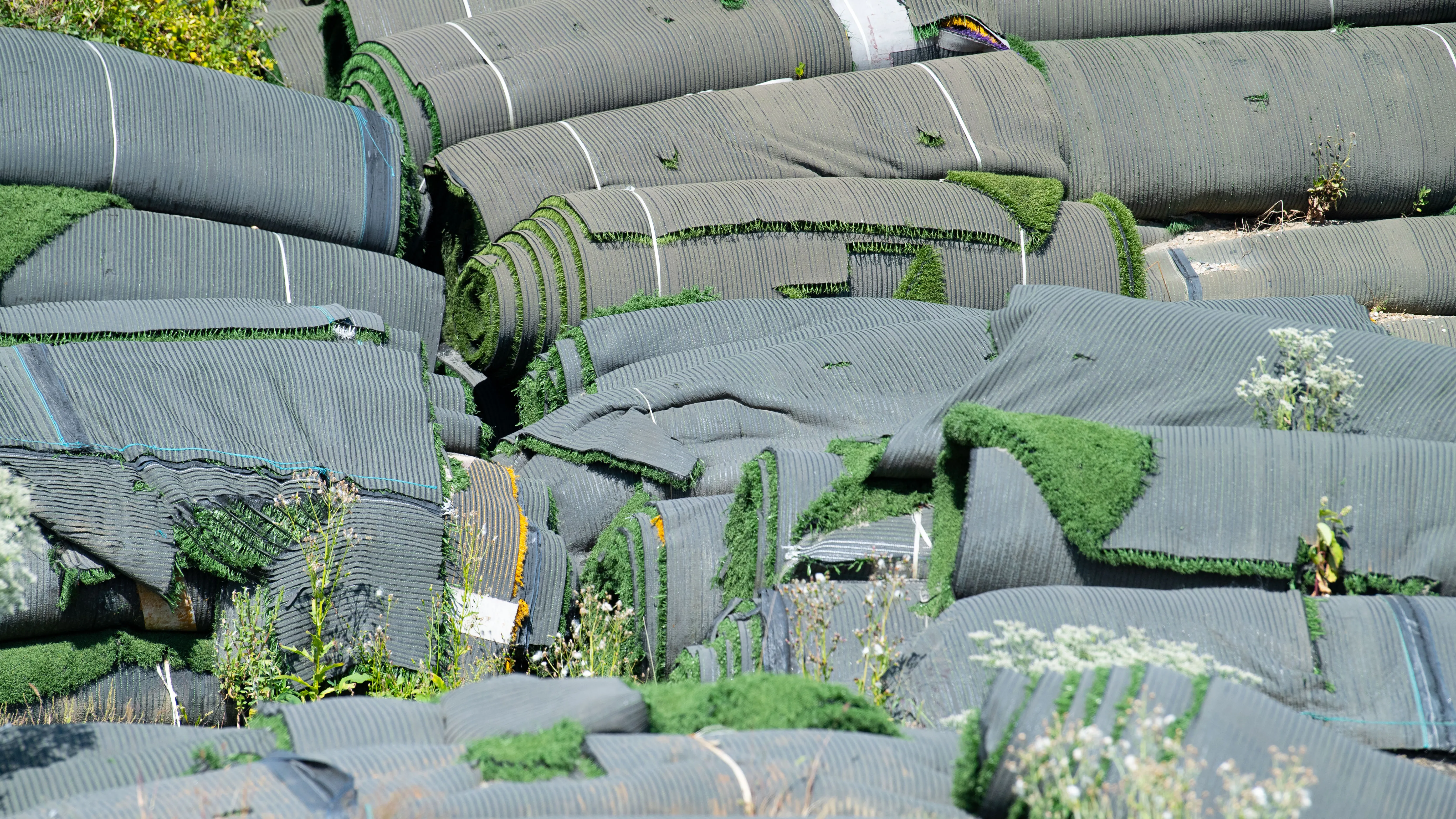
Artificial turf systems do not last forever. Quality residential installations have service lives in the twelve to twenty year range, and commercial applications under heavy traffic loads may see shorter service periods. As the east-Collin growth corridor matures — some of its earliest master-planned communities from the early 2000s are now over twenty years old — the demand for professional artificial turf removal has grown alongside the initial installation market.
Artificial Turf of Wylie provides professional removal and disposal services for residential and commercial synthetic turf systems throughout the growth corridor. We remove turf installed by any company, prepare the site for whatever comes next, and manage disposal appropriately. Removal can be a standalone service or combined with new turf installation in a single project sequence.
When Removal Is the Right Next Step
End of Installation Service Life
Artificial turf systems that have reached the end of their service life exhibit identifiable characteristics: significant fiber degradation or fading that cannot be addressed through maintenance, backing separation or delamination across large areas, widespread drainage failure despite maintenance attempts, or structural damage that exceeds economical repair scope. When multiple systems issues converge, replacement is more cost-effective than continued repair investment.
The east-Collin growth corridor's earliest artificial turf installations — many of which went in during the 2002 to 2010 period in the first phases of Wylie's master-planned developments — are entering this end-of-life window now. Homeowners who have had these systems for fifteen or more years are evaluating whether to remove and replace with current-generation products that outperform what was available when the original system was installed.
Upgrade to Current-Generation Products
Synthetic turf technology has improved significantly since the mid-2000s. Fiber construction, UV resistance, infill formulations, and backing drainage performance in current products are meaningfully better than what was installed in the growth corridor's first residential turf wave. Some homeowners with older but structurally sound installations choose to remove and replace not because the original system has failed, but because the improvement in product performance is substantial enough to justify the upgrade.
Property Transaction and Conversion
Real estate transactions in the east-Collin market occasionally require artificial turf removal — buyers who prefer natural grass, sellers who want to address an aging system before listing, or commercial property transfers where the new owner has different landscape plans for the space. We provide removal services for property transaction contexts with flexible scheduling and fast completion timelines.
Base System Failure Requiring Full Removal
Some artificial turf problems originate in the base system rather than the turf itself. Widespread drainage failure caused by base compaction, settling, or organic intrusion sometimes cannot be economically remediated without full removal and base reconstruction. In these cases, removing the turf to access and correct the base condition is the appropriate path, followed by reinstallation of new turf on a corrected base.
Our Removal Process
Site Assessment
We begin with a site assessment that identifies the turf system type, the base material composition, the area dimensions, and any site-specific challenges that affect the removal approach — existing hardscape adjacent to the turf, underground irrigation systems that run under the installation area, or trees with surface roots that complicate base removal.
Turf Removal
Artificial turf is cut into manageable sections and rolled for removal. Infill material is vacuumed or swept prior to turf removal where practical, and the removed turf sections are loaded for transport. The process is designed to minimize disturbance to adjacent landscape features and hardscape.
Base Material Handling
Existing base material assessment determines whether it can be reused for new installation or requires removal. In east-Collin County, original base materials sometimes compact or degrade in ways that make them unsuitable for direct reuse under a new turf system. We assess base condition and advise on whether partial or full base removal and replacement is appropriate.
For new installation projects that follow removal, we typically include a base assessment and specification as part of the combined removal-and-installation project, ensuring that the new system's drainage performance is built on a correctly prepared foundation.
Disposal
All removed turf and base material is transported to appropriate disposal or processing facilities. We work with facilities that recycle turf components where processing options are available in the North Texas region, and all disposal complies with applicable regulations.
Site Preparation for What Comes Next
After removal, the site is graded and prepared for the next use — whether that is new artificial turf installation, natural sod, hardscape, or some other application. We leave the site in a condition appropriate for the next phase of the project rather than simply clearing material and departing.
Combined Removal and Reinstallation Projects
Many customers choose to combine removal and new installation into a single project. The combined approach is more efficient than staging the projects separately — we complete removal, perform any necessary base reconstruction, and install the new turf system in one continuous operation. This minimizes the time during which the yard or commercial property area is out of service.
Contact Artificial Turf of Wylie at to discuss your removal project. We serve residential and commercial removal applications throughout the east-Collin growth corridor and surrounding communities with free site assessments and no-obligation proposals.