Custom backyard putting greens have become one of the most popular artificial turf investments in the east-Collin growth corridor, and the reasons are practical as well as recreational. The homeowners arriving in Bozman Farm, Inspiration, Hampton Heights, and the newer phases of Grand Heritage Lavon are often professionals who commute the Tollway to Plano or Richardson corporate campuses and play golf on weekends. They are buying houses with backyards that are underutilized — yards with builder-sod lawns that are either struggling or simply sitting there as an expensive maintenance obligation — and a backyard putting green converts that space from a maintenance burden into a recreational asset.
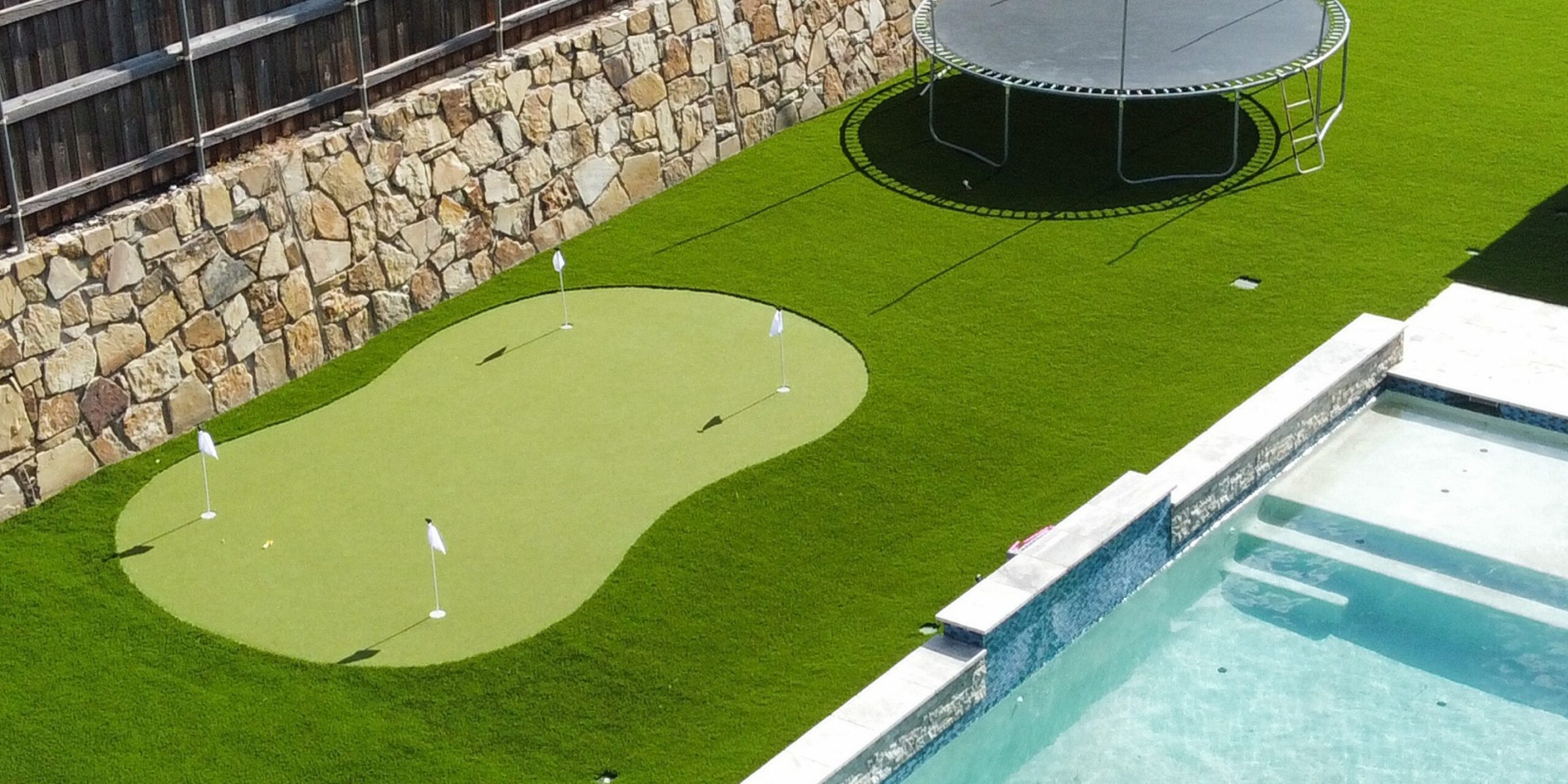
Artificial Turf of Wylie designs and installs custom putting greens scaled to the typical newer-construction east-Collin backyard. We do not require an acre to build a functional, playable putting surface. A well-designed green in a 400 to 800 square foot backyard section can include multiple cups, realistic contours, and a ball roll surface that mirrors what you would find on a well-maintained club green.
Putting Green Design Principles
A backyard putting green is both a landscaping project and a functional golf practice facility. The design has to satisfy both requirements — it needs to look like a premium backyard feature and it needs to perform as a credible practice tool. Cutting corners on either dimension produces a product that disappoints in the first season.
Ball Roll and Stimp Speed
Putting green turf is a completely different product from the residential landscape turf we install elsewhere in the same backyard. It is a shorter-pile, higher-density fiber product engineered specifically for the directional ball roll behavior that makes putting practice meaningful. The stimp speed — how far a ball rolls under standardized conditions — is determined by the turf product choice, the infill material and density, and the degree of fiber nap direction.
We specify putting green turf products with stimp speeds in the 8 to 11 range for residential backyard applications — the range where recreational and low-handicap amateur golfers find practice most useful. Tournament-speed greens at 12 and above are available but require consistent maintenance attention to hold their speed over time.
Contouring and Break Design
Flat putting greens are practice tools for putting mechanics, but they do not simulate course conditions. A properly designed backyard green includes subtle contours — breaks of one to three degrees in multiple directions — that make a 20-foot putt behave like a course putt rather than a flat-surface roll. Contouring is built into the sub-base during installation, not painted on the surface afterward.
Our design process for backyard greens includes a contouring conversation during the site assessment: where do you want the primary break direction, how challenging do you want the longest putt, and how does the green's shape interact with the surrounding fence lines and hardscape? These questions shape the base-grading plan before we cut any material.
Cup Placement and Fringe Design
A putting green with only one cup is an improvement over nothing, but multiple pin positions turn a simple stroke practice tool into a green that simulates actual course strategy. We typically install three to four cups on a mid-size residential green, positioned to create meaningful distance and break variation between them.
Fringe — the slightly longer-pile border that separates the putting surface from the surrounding landscape — frames the green visually and creates a transition that makes the installation look like a intentional feature rather than a patch of short grass. Fringe design is one of the finishing details that most clearly distinguishes a professionally installed green from a DIY one.
Putting Green Construction Process
Site Assessment and Design
We visit your property to assess the available space, discuss your skill level and practice goals, and design a green that fits both the physical constraints and your functional requirements. We bring product samples to let you evaluate fiber texture and discuss stimp speed targets.
Base Construction
Proper base construction for a putting green is more demanding than standard residential turf installation because the surface needs to be precisely graded to achieve the intended contours. We excavate the area, establish the contour grades with compacted base material, and install drainage to prevent water pooling on a relatively flat, low-permeability surface.
Turf Installation and Cup Setting
Putting green turf goes down on the prepared base with careful attention to fiber direction — the nap direction affects ball roll, and consistent nap orientation throughout the green produces predictable putting behavior. Cups are set in pre-planned positions with proper depth and angle to simulate real hole conditions.
Fringe and Surrounding Integration
The fringe border and the transition to surrounding landscape turf, hardscape, or natural grass complete the installation. Clean, professional transitions are the mark of a properly finished putting green.
Serving the East-Collin Golf Community
Artificial Turf of Wylie serves putting green projects throughout the east-Collin growth corridor, including all Wylie neighborhoods, Murphy, Sachse, Allen, McKinney, Plano, Frisco, and the surrounding communities. Our Wylie address puts us in the middle of one of the densest concentrations of suburban golf households in the North Texas market.
Contact us at to schedule your backyard putting green consultation. Free site assessment and custom design at no obligation.